
Impact
Most of our results are joint work of several projects; the project codes show which projects contributed.
More details are given on our publications page.
AI and algorithms
- Connected and bi-objective clustering – A1, A2
- Clustering of curves and time series under the Fréchet distance – A3, B1
- Graph distances: models and exact algorithms – B2, C1
- Published at the leading venues in algorithms (SoCG, ICALP, ESA, STOC, IEEE TVCG) and in AI and data analytics (NeurIPS, KDD, VLDB, SDM, Information Fusion)
Geodesy and cartography
- Building generalization and aggregation with provable guarantees – A1, B1, B2, C1
- Reconstruction of past sea level from tide gauges and satellite data – A1, A2, B1, B2, C2
- Climate patterns in radar altimetry – A1, A2, A3, C2
- Published in ACM TSAS, ACM SIGSPATIAL, PFG, ISPRS Annals and Earth System Science Data
A new community
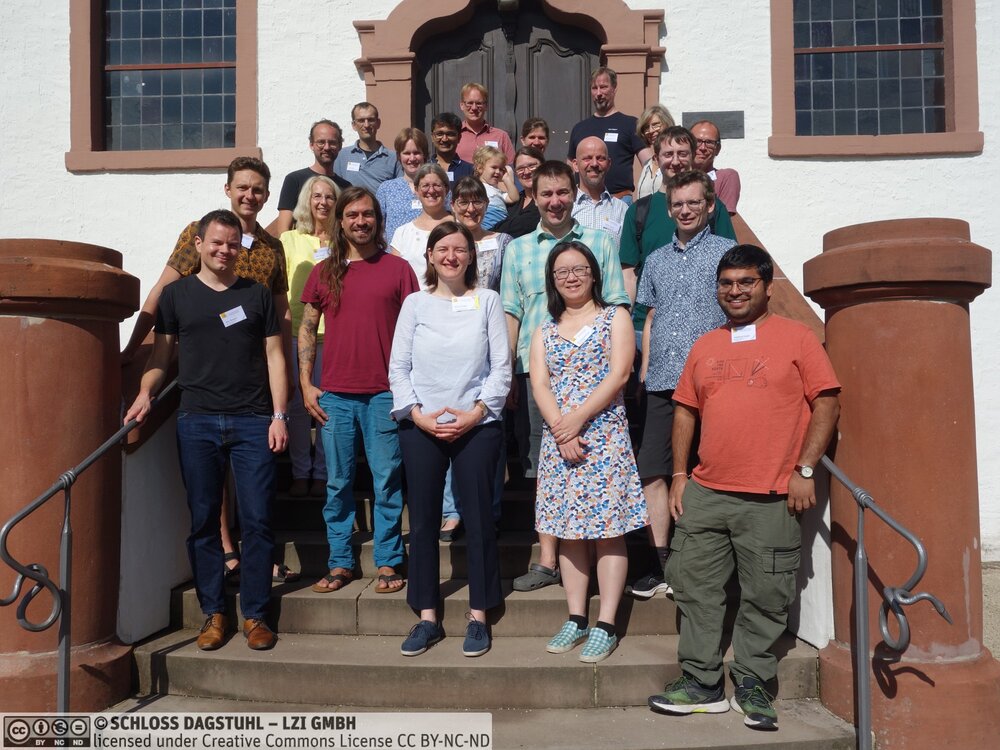
- Dagstuhl Seminars “Computational Geometry of Earth System Analysis” (2023) and “Interfacing Maps and Text with AI” (2026)
- Workshops: Computational Cartography, Geometric Graphs, CartoAI, Machine Learning for Geodesy and Geoinformatics (German Geodetic Commission)
- AlgoEarth: Semester of Algorithmic Earth System Sciences with the Universities of Cologne and Bonn, Forschungszentrum Jülich and ECMWF
- AlgoForGe is a research pilot of CESOC (Center for Earth System Observation and Computational Analysis) and embedded in Bonn's Transdisciplinary Research Areas
Awards and competitions
- Best Student Paper Award, SoCG 2026: Lotte Blank for “Fréchet distance in the imbalanced case” – B1
- ACM SIGSPATIAL GIS Cup 2026, 2nd place: L. Bülte, D. Faber, M. Kaibel, B. Kolbe, P. Mayer, L. Müller, P. Mutzel, F. Roth – B2
- CG:SHOP 2026 (Computational Geometry Challenge at SoCG), 4th place: J. Conradi, B. Kolbe, P. Mayer, J. Sauer, J. Spalding-Jamieson, with the paper “Engineering greedy heuristics and simulated annealing methods for the median triangulation under the parallel flip distance” – B2
- Best paper finalist, SEA 2024: Philip Mayer (with Petra Mutzel) for “Engineering A* search for the flip distance of plane triangulations” – B2
- Nomination for the FTI Prize 2025: Johanna Hillebrand – A2
- Grace Hopper Prize: Franziska Kehe and Charlotte Bockhorst for their theses – B2
- BIG thesis prizes: Charlotte Bockhorst, Franziska Kehe, Michael Kaibel and Lars Müller for their theses – B2
Research Data and Software
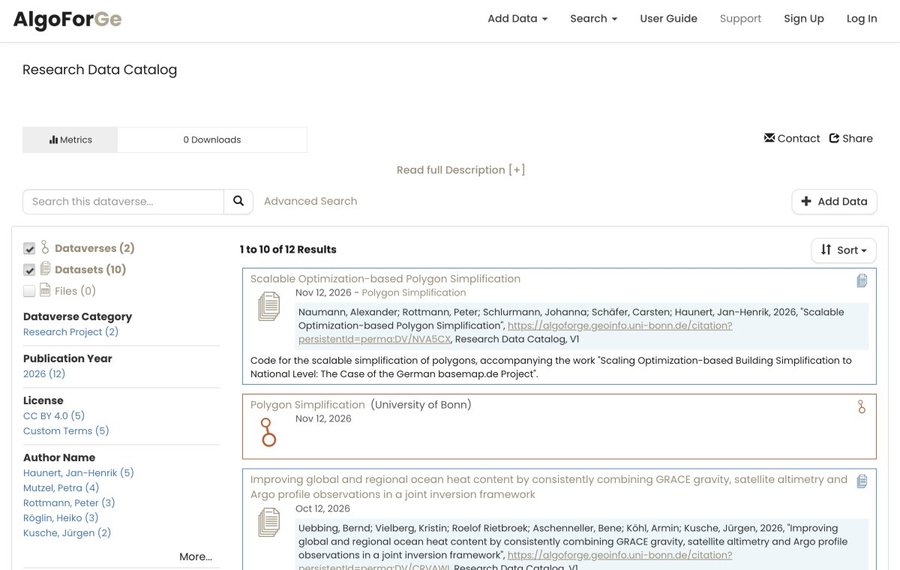 We publish data and code together with our papers, so that our results can be reproduced and our
methods can be used in practice. All datasets and software of the research unit are collected in the
AlgoForGe Research Data Catalog,
a Dataverse repository hosted at the University of Bonn.
Two of our data sets serve as benchmarks for the wider community:
- DIMACS Implementation Challenge: our polygon aggregation instances have been accepted as benchmark instances for the 13th DIMACS Implementation Challenge “Network Flows 2.0” (2026–27), where they will be solved by all participants (data) – B2, C1
- ExactGED: provably optimal graph edit distances for standard benchmark data sets, computed with our exact ILP solver, as ground truth for exact, approximate and learning-based methods (ECML/PKDD 2026 Workshops, to appear) – B2
- Code for scalable optimization-based polygon simplification, as used for the buildings of basemap.de
- Monthly ocean heat content from combining GRACE gravity, satellite altimetry and Argo profiles
- Connected subspace clustering with an application to sea level geodesy
- Polygon aggregation: code and Pareto sets
- Exact algorithms for p-regions, maximum k-cut and monotone parametric minimum cut
Transfer and Outreach
Official map of Germany – C1
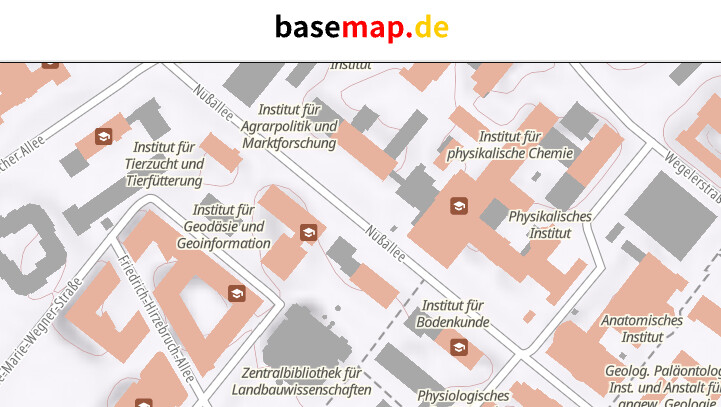 A building simplification algorithm developed in project C1 is deployed for
basemap.de, the official web map of Germany.
Since October 2026, more than 60 million buildings are online.
Figure: Screenshot of basemap.de (AdV).
Global ocean warming – C2
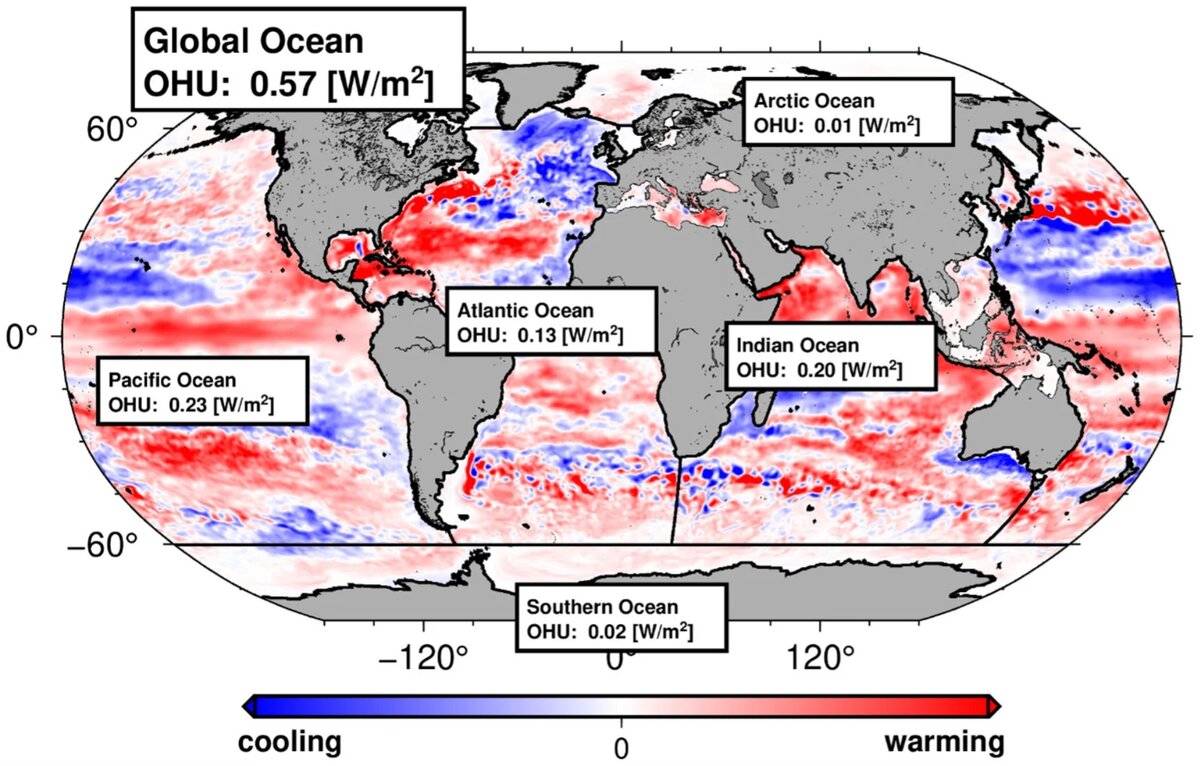 Our estimate of ocean heat content (Earth System Science Data 2026) has been included in the
2nd WCRP GEWEX Earth's Energy Imbalance assessment, where it is compared with, e.g., ECMWF coupled
modelling and NASA CERES observations. The University of Bonn published a
press release, which was
also distributed via idw.
Figure: Heat energy uptake (OHU) in the major ocean basins (figure: Bernd Uebbing/University of Bonn).
Outreach
- Podcasts: Hypothese (University of Bonn) and University of Texas at Austin; article in GEWEX Quarterly
- Public panels: Mathenacht 2024; “KI und Klima” 2025 (Stiftung Wissen)
- Schools: Girls' Day, open days, programming contests
- Practice: GeoIT Round Table NRW; open data and code in our Research Data Catalog